
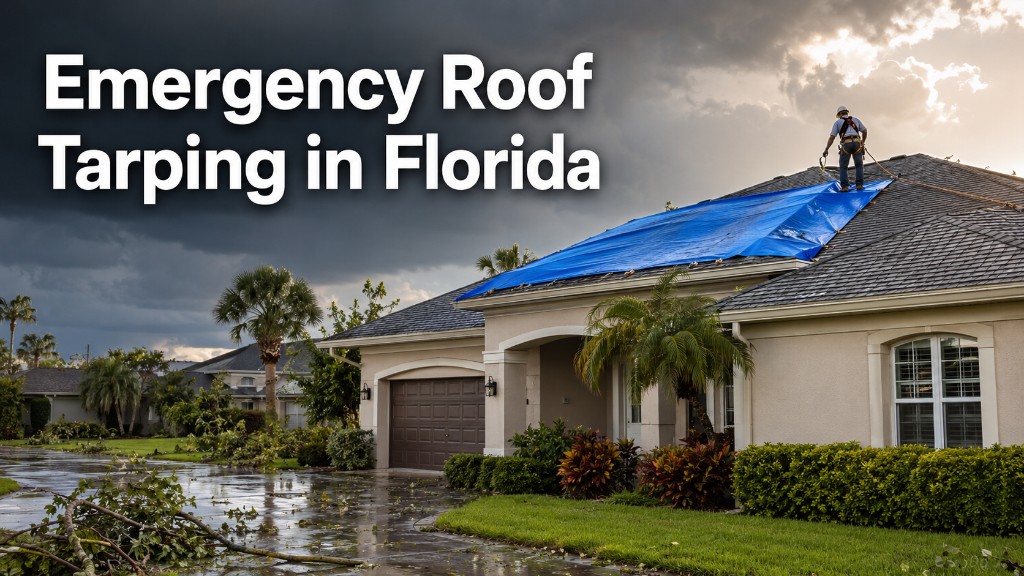
The roof is open, it’s going to rain again tonight, and every roofer within forty miles is booked. Somewhere in that scramble a decision gets made about tarping — usually fast, usually with no information, and usually by whoever picks up the phone first.
That decision has more effect on your insurance claim than almost anything else you’ll do in the first week. Not because a tarp is expensive, but because of what happens to the damage underneath while you wait — and because of who ends up holding the invoice.
Here’s how it actually works in Florida.
Quick answer
Emergency roof tarping in Central Florida typically runs $400–$900 for a straightforward single-story shingle roof, and $1,000–$2,500 for steep, tile, two-story, or multi-area work. Your homeowners policy covers reasonable emergency measures to prevent further damage, and you have a duty under the policy to take them. Many policies cap what they’ll pay for emergency measures at the greater of $3,000 or 1% of your Coverage A limit unless you request approval to exceed it. Because Florida ended assignment of benefits for policies issued on or after January 1, 2023, you will most likely pay the tarping contractor directly and be reimbursed — so keep the itemized invoice and photograph the damage before the tarp goes on.
Tarping isn’t a repair decision. It’s a coverage decision.
Every Florida homeowners policy contains a duties-after-loss provision requiring you to protect the property from further damage. It’s not optional and it’s not a suggestion — it’s a condition of your coverage.
This is where homeowners get hurt. A tree opens the roof on Tuesday. It rains Wednesday and Thursday. By the time an adjuster inspects the following week, there’s saturated insulation, stained drywall, and the beginnings of a mold problem in two bedrooms.
The carrier now has a very reasonable-sounding argument: the wind damage is covered, but the interior damage happened because you didn’t act. That’s a failure-to-mitigate denial, and it’s one of the most common ways a legitimate storm claim gets carved down.
The reverse is also true, and it’s the part nobody mentions. Tarping promptly doesn’t just limit your loss — it documents that you did what the policy required. That’s a good fact to have on file when the adjustment gets contentious.
Do not wait for your adjuster to authorize a tarp. You will wait days. The policy expects you to act, and reasonable emergency measures are reimbursable whether or not anyone approved them in advance.
What tarping actually costs in Central Florida
Pricing varies with pitch, height, material, access, and how many separate areas need covering. Tile is more labor than shingle. A second story is more than a first. Steep pitch means fall protection and slower work.
| Scenario | Typical range |
|---|---|
| Single-story shingle, one area, walkable pitch | $400 – $900 |
| Two-story, steep pitch, or tile roof | $1,000 – $2,500 |
| Multiple separate damage areas | $1,500 – $3,500+ |
| Shrink-wrap system (longer-term, storm-rated) | $2.50 – $5.00 per sq. ft. |
Treat these as planning numbers, not quotes. After a named storm, availability drives price more than scope does.
One caution worth naming: Florida activates its price gouging statute during a declared state of emergency, and it applies to essential commodities and services in the declared area. If a post-storm tarp quote looks wildly out of line with the ranges above, that’s worth a second call before you sign anything.
What your insurance will actually pay
Reasonable emergency measures are covered. That’s the general rule and it’s rarely disputed in principle. Where it gets complicated is the ceiling.
The $3,000 or 1% figure. You’ll see this number everywhere, usually stated as if it were Florida law capping what insurers must pay. That’s not quite right, and the distinction matters.
The statutory version of that cap lives in Florida Statute 627.7152, which provides that when a property owner acts under an urgent or emergency circumstance and executes an assignment agreement to protect, repair, restore, or replace property or mitigate further damage, the assignee may not receive an assignment of post-loss benefits exceeding the greater of $3,000 or 1 percent of the Coverage A limit. That’s a limit on what a contractor can take by assignment — not a universal statutory cap on the carrier’s obligation to you.
Separately, many carriers write a similar cap directly into their policy forms, typically with a mechanism to request approval to exceed it. Read your own policy language. If your emergency measures are going to run past that threshold, put the request in writing before the work goes beyond it, and keep the response.
The AOB change most homeowners haven’t caught up with. Under Senate Bill 2-A, assignment agreements are invalid and unenforceable for any residential or commercial property insurance policy issued on or after January 1, 2023.
Practically, this means the old model — where you signed a form and the tarping company billed your carrier directly — is gone for most policies written in the last few years. You pay, and you get reimbursed. That single change is why documentation now matters far more than it used to:
- Get an itemized invoice, not a lump sum. Labor, materials, square footage, date of service.
- Pay by a method that leaves a record. Cash with no receipt is money you may never see again.
- Submit it with your claim rather than assuming the adjuster will ask.
Photograph the damage before the tarp goes on
A tarp is, by design, a thing that hides the damage.
Once it’s down, the adjuster sees blue poly. Your photos become the only record of what was actually underneath — and if those photos don’t exist, the scope of the loss becomes a negotiation instead of a fact.
Before the tarp:
- Wide shots from the ground on all four elevations
- Close shots of the opening itself, with something for scale
- Any interior water intrusion, ceilings, walls, insulation
- Timestamps enabled
Then photograph the tarp installation itself. It proves the work was done, on what date, and to what extent — which is exactly what a reimbursement request needs.
Our companion guide on what to do after a storm damages your roof in Florida walks through the full documentation sequence, including how to inspect safely from the ground.
How long does a tarp last?
Not as long as people assume, and considerably less than that in Florida sun.
| Type | Realistic service life |
|---|---|
| Standard poly tarp, properly fastened | 30 – 90 days |
| Heavy-duty reinforced tarp | 90 – 180 days |
| Shrink-wrap system | 6 – 12 months |
| Peel-and-stick underlayment (dry-in) | 6 – 12 months |
UV degradation is the limiting factor. A tarp that looked fine in September can be brittle and shredding by December, and a failed tarp in January produces a second water loss that your carrier will treat as a separate — and much harder — claim.
If your claim is going to take months to resolve, a tarp is the wrong tool. Ask about a temporary dry-in with peel-and-stick underlayment instead. It costs more up front, it survives the wait, and in most cases it becomes part of the permanent system when the roof is finally replaced.
Five mistakes that cost real money
1. Waiting for the adjuster. Covered above, but it’s the expensive one. Act, document, submit.
2. Signing something without reading it. After a storm, people sign whatever is on the clipboard. Florida gives you an out here: a residential property owner may cancel a contract to replace or repair a roof without penalty or obligation within 10 days after execution. Know that the window exists.
3. Taking the “free tarp” deal. Florida law is explicit that a contractor may not offer a rebate, gift, gift card, cash, coupon, waiver of any insurance deductible, or anything else of value in exchange for allowing a roof inspection or for making an insurance claim on the roof. A free tarp offered in exchange for the roof job is not generosity — it’s a red flag about how the rest of that relationship will go.
4. Hiring whoever knocked. Verify the license before anyone touches the roof. Roofing work requires a licensed contractor, and license status is public and searchable through the Florida Department of Business and Professional Regulation. A legitimate contractor will hand you the number without being asked.
5. Letting the tarp become the plan. Tarps buy time. They don’t resolve claims, and a claim that stalls for six months under a degrading tarp usually ends worse than one that gets pushed. If your carrier has gone quiet or the offer doesn’t cover a real repair, that’s the point to get help — and the person who does that work is a licensed public adjuster, not your roofer. How to choose the right contractor for your claim covers where that line sits and why it matters.
Frequently asked questions
Does homeowners insurance pay for roof tarping in Florida? Yes. Reasonable emergency measures to prevent further damage are covered under standard Florida homeowners policies, and you have an affirmative duty under the policy to take them. Keep the itemized invoice — for most policies issued on or after January 1, 2023, you’ll pay the contractor and be reimbursed rather than having them bill the carrier directly.
Do I need my insurance company’s approval before tarping? No, and waiting for it can hurt you. The policy requires you to protect the property from further damage. Act first, document thoroughly, and notify your carrier promptly. If the emergency work will exceed your policy’s cap on emergency measures, request approval in writing before going past that amount.
How much does emergency roof tarping cost in Central Florida? Typically $400–$900 for a single-story shingle roof and $1,000–$2,500 for steep, tile, two-story, or multi-area work. Post-storm demand affects pricing significantly.
Can a roofing contractor bill my insurance company directly for the tarp? Usually not anymore. Assignment agreements are invalid and unenforceable for residential property policies issued on or after January 1, 2023. Homeowners with older policies may still have that option.
How long can I leave a tarp on my roof? Plan on 30–90 days for a standard tarp in Florida sun. If the claim will take longer, a temporary dry-in with peel-and-stick underlayment is the better decision — a failed tarp creates a second water loss that’s far harder to get covered.
Will tarping my roof hurt my insurance claim? No — failing to tarp is what hurts claims. The one risk is tarping before you’ve documented the damage underneath, which leaves you without evidence of the original scope. Photograph first, then cover.
If your roof is open right now
Call us at 407-205-2676. We’re a licensed Florida roofing and general contractor based in Maitland, and we handle emergency tarping and temporary dry-in throughout Orange, Seminole, Lake, Volusia, Brevard, and Osceola counties.
If the roof is holding for now but you’re not confident it will survive the rest of the season, that’s a better problem to solve this week than next. Our free Florida roof lifespan calculator is a two-minute starting point, or reach out through our contact page for a professional inspection.
Orange Contracting and Appraisal, Inc. d/b/a Orange Contracting and Roofing is a licensed Florida roofing contractor (CCC1337502), certified roofing contractor (CRC1336049), and certified general contractor (CGC1540193), located at 105 Candace Dr., Suite 129, Maitland, FL 32751.
This article is general information about Florida property insurance and construction practices. It is not an interpretation of any individual policy and not a substitute for advice about your specific claim. Under Florida law, only a licensed public adjuster may interpret policy provisions or adjust a claim on a policyholder’s behalf. For questions about your own coverage, consult your policy, your carrier, or a licensed public adjuster.